
Commercial mortgage guide · British Columbia
Commercial mortgages in BC, explained step by step
I wrote this guide for business owners and investors who want to know how a commercial mortgage really comes together in BC: how lenders size the loan, what they read, how long it takes and what it costs beyond the interest.
Talk through my commercial deal
Free 15-minute call by phone or video. I review your situation myself.
James Park, Your Mortgage Pal · How I work · Licensed mortgage broker, Verico Paragon MortgagePal Inc. · Office: 227-5589 Byrne Road, Burnaby, BC V5J 3J1

Commercial is not a bigger home mortgage
When I place a home mortgage, the lender mostly asks one question: can this household carry the payment from its income? A commercial mortgage asks a different one: can this property, and the business or tenants inside it, carry the debt on their own, and is there enough value and borrower strength behind it if something goes wrong?
That single shift changes almost everything about the file. The appraisal is longer and more detailed. The lender reads leases, rent rolls and financial statements instead of pay stubs. Third-party reports, such as an environmental review, are common. The paperwork is different for every deal, and the loan is often reviewed every year after it funds. A home purchase can close in about a month. For a commercial deal, I tell clients to plan for about four months or more.
None of that is a reason to avoid commercial property. It is a reason to start early, put the file together properly and let lenders compete for it. That is the part I do. If you already have a deal in front of you, my commercial intake form is the fastest way to get it to me.
The commercial files I help with
I work with owners and investors across BC on these kinds of deals:
- Owner-occupied commercial property. You buy or refinance the building your own business operates from: a warehouse bay, a clinic, a shop, an office floor.
- Investment property. Retail, office, industrial and mixed-use buildings leased to tenants.
- Multi-family buildings of 5 or more units. These are financed as commercial loans, including CMHC-insured programs.
- Construction, development and land. From land and site work through to a finished project.
- Business and property acquisitions. Buying a business, a competitor or a building, with or without real estate in the deal.
- Refinancing, restructuring and bank exits. When your lender will not renew, wants out, or your debt needs a new structure.
- Private commercial lending. Real-estate-secured options for files a bank is not ready to do yet.
On commercial files I work alongside an experienced commercial financing partner. I stay your point of contact from the first call to funding.
What a lender looks at, by type of deal
The type of deal decides which numbers matter most. This is the map I start from.
| Type of deal | What the lender leans on most | What I gather first | Typical pace |
|---|---|---|---|
| Owner-occupied (your business uses the building) | Your business's cash flow and financial statements, plus the property | Two years of business financials, the purchase contract, what the space is used for | Months, not weeks |
| Investment property (retail, office, industrial, mixed-use) | The rent the tenants pay, lease length and tenant quality | Rent roll, copies of the leases, operating costs, property tax | Months, not weeks |
| Multi-family (5 or more units) | Net operating income and debt coverage; CMHC-insured options exist | Rent roll, operating statement, building condition, your net worth | Longer when CMHC insurance is involved |
| Construction, development and land | The project budget, your experience, presales or lease-up plan | Budget, permits, drawings, team, schedule of draws | Staged: approval, then advances as work is done |
| Refinance or bank exit | The property's current income and the reason for the change | Current loan statement, the lender's letter, recent financials | Start as early as you can |
How a lender sizes a commercial loan
Three tests do most of the work. A commercial loan is usually sized by whichever of them gives the smallest number.
1. Value and loan-to-value. The lender orders an appraisal from a commercial appraiser and lends a share of that value. The share depends on the property type, its location, its condition and the lender. A multi-tenant industrial building and a single-use special-purpose property can be treated very differently even at the same value.
2. Debt coverage. This is the test most people have not met before. The lender takes the property's net operating income, which is the rent and other income minus vacancy and operating costs (but before the mortgage payment), and divides it by the yearly mortgage payments. The answer is the debt coverage ratio. If the result is above the lender's minimum, the property carries its own debt with a cushion. If it falls short, the loan gets smaller or the structure changes. For a sense of scale, CMHC's MLI Select program sets a minimum debt coverage of 1.1 for standard rental housing, and a higher bar for non-residential space.
3. The borrower behind the deal. Commercial lenders look at your net worth, how much cash you can show after closing, your credit and your experience owning or running this kind of property. They do not lean on your personal income the way a home lender does, but a strong borrower can still change the answer on a borderline file.
For an owner-occupied building, the "income" is your business's ability to pay. That is why I ask for two years of business financial statements early, and why clean, up-to-date books make such a difference.
Multi-family: CMHC options for 5-plus units
Once a building has 5 or more self-contained units, it is a commercial file, and CMHC-insured financing becomes an option alongside conventional loans.
CMHC's MLI Select program uses a points system. A borrower earns points by committing to affordability, energy efficiency or accessibility, and a minimum of 50 points is needed to use the program. More points unlock more flexibility: higher loan-to-value, longer amortization and lower premiums. At 100 points the amortization can reach up to 50 years, but never more than the building's remaining economic life as CMHC sees it. A project needs at least 5 units, and non-residential space cannot exceed 30 per cent of the gross floor area or of the total lending value.
There is also a change coming. In November 2026 the federal government published parameters for new insured products for properties of 5 to 50 units, offered by private mortgage insurers, for applications submitted on or after February 1, 2027. The published limits include a maximum loan of 85 per cent of value for purchases and refinances (90 per cent for new construction), amortization of up to 40 years (50 for new construction), and a borrower net worth of at least 25 per cent of the loan amount, with a minimum of $100,000. I am watching how lenders put these into practice and will update this guide as they do.
Insured multi-family financing has real advantages, but it is also slower and has its own premium and paperwork. I lay out the insured and the conventional route side by side so you can see which one fits your plan for the building.
Mixed-use buildings: two kinds of space, one loan
A building with shops or offices on the ground floor and apartments above is one of the most common commercial files I see in BC town centres. Lenders treat the two kinds of space differently. The residential units usually look steadier to a lender, because apartments re-lease quickly. The commercial units depend on the tenant, the lease term and how easy the space would be to fill if it went empty.
So the questions I ask on a mixed-use deal are about the split. How much of the income comes from the commercial space? How long do those leases run, and are the tenants established businesses? Is the commercial space a small part of the building, or most of it? The answers decide which lenders will look at it and whether an insured multi-family route is even possible, since CMHC limits how much of an insured building can be non-residential.
If you are looking at a mixed-use property, send me the rent roll and the leases before you write an offer. I can usually tell you quickly which lenders will be comfortable with it.
Environmental checks in BC
Environmental questions catch more commercial buyers by surprise than anything else. Many lenders ask for an environmental report on commercial and industrial property before they will fund.
BC also has its own rule. Under the Environmental Management Act, a Site Disclosure Statement is required when land has had one of the industrial or commercial uses listed in Schedule 2 of the Contaminated Sites Regulation, and someone is, for example, selling the property or applying for zoning, subdivision, or a development or building permit that will disturb soil. Some exemptions apply. Past uses such as fuel storage or vehicle repair are the kind of history that comes up.
I raise this on the first call, not the last week. If a report is likely, we order it early so a surprise does not push back your closing date.
The timeline, start to funding
Here is how a typical file moves. Some take longer, especially construction and insured multi-family.
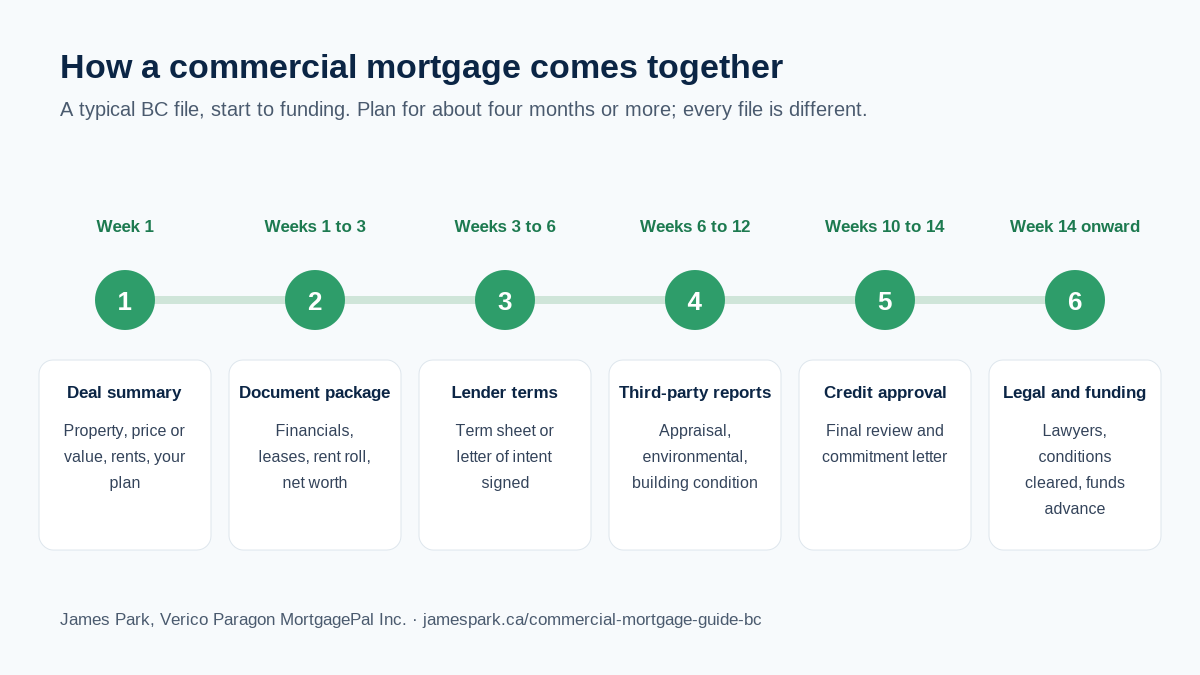
Read the text version
- Deal summary (week 1): the property, the price or value, the rents and your plan.
- Document package (weeks 1 to 3): financial statements, leases, rent roll and your net worth statement.
- Lender terms (weeks 3 to 6): a term sheet or letter of intent is signed.
- Third-party reports (weeks 6 to 12): appraisal, environmental report and, often, a building condition report.
- Credit approval (weeks 10 to 14): the lender's final review and the commitment letter.
- Legal and funding (week 14 onward): lawyers clear the conditions and the funds advance.
Plan for about four months or more. Every file is different.
The step that slips most often is the document package. When the statements, leases and rent roll arrive in the first week or two, everything after it moves faster.
The documents I ask for
Every commercial file is different, but most start with the same core:
- A personal net worth statement for each borrower and guarantor
- Your credit report
- The last 2 years of T1 Generals and Notices of Assessment, with taxes paid up
- For a holding company: certificate of incorporation, notice of articles, the central securities register and a list of directors and officers
- The last 2 to 3 years of financial statements for the business or the property
- For an investment property: a current rent roll, copies of the leases and a statement of operating costs
- The property tax notice and the insurance details
- The purchase contract, or the current mortgage statement for a refinance
If you are not sure what applies to your deal, send me what you have. I will tell you what is missing before anything goes to a lender.
Free download
Get the Commercial Mortgage Document Checklist
Tell me where to send it and the PDF opens right away. I will follow up once, personally.
Costs to plan for, beyond the interest
A commercial mortgage has more moving parts than a home loan, and each one has a cost. Before you commit, I lay them out in writing:
- Appraisal. A commercial appraisal is more detailed and costs more than a residential one.
- Environmental and building reports. Often required on commercial and industrial property, and on older buildings.
- Legal fees. Commercial closings take more legal work than home purchases.
- Lender and broker fees. These are common on commercial files and are disclosed up front.
- CMHC premium. On insured multi-family loans, a premium is added to the loan.
- Ongoing reviews. Many commercial loans ask for updated financial statements each year.
The cheapest-looking quote is not always the cheapest loan once fees, prepayment terms and covenants are counted. I compare the whole package, not one number.
When your lender will not renew
A bank that wants out of a commercial loan is more common than people think. It can happen because the lender's appetite changed, the property's income dipped, or the loan no longer fits their rules.
If you get that letter, start right away. A refinance needs a new appraisal and a full lender review, so the four-month clock applies. Options usually include moving the loan to another bank or credit union, a lender with a different appetite for the property type, or a short private bridge while the property is repositioned. I tell you which route is realistic for your file and what each one costs.
Owner-occupied: buying the building your business runs from
Owning your premises can give you control over your space and your costs, and can build equity alongside the business. It also ties up cash and concentrates risk in one place. The financing question is whether your business's cash flow comfortably carries the debt, and whether the property would still make sense to a lender if a different tenant were in it.
If your company will hold the property, the lender looks at the company and the people behind it, and usually asks the owners to sign for the loan personally as well. Talk to your accountant about how to hold the property for tax purposes. I take that structure and find the lenders who are comfortable with it.
How I work on a commercial file
- We talk first. A short call about the property, your plan and your timeline. I tell you plainly if I think the deal will be hard to finance.
- I build the package. I collect your documents, write the deal summary and fix the gaps before a lender sees it.
- I shop it. I take the file to the types of lenders that fit: banks and credit unions, insurance companies and pension funds, asset-based lenders, and private and alternative lenders. Competition between them is how you get better terms.
- We compare terms side by side. Loan amount, amortization, prepayment terms, covenants, fees and reporting, in plain English.
- I stay on it to funding. Reports, lender conditions and the lawyers, through to the day the money advances.
All financing is subject to lender approval, and approval is never certain. What I can promise is a properly built file and a straight answer at each step.
Three things I see sink commercial deals
- Starting too late. A purchase contract with a short financing condition and a lender that needs four months is a problem I would rather solve before you sign.
- A value the appraisal will not support. I look at what comparable properties and the rents say before you make an offer, not after.
- Surprises in the history of the site. Past industrial use, or missing leases and estoppel letters, can stall a file late. I ask about them first.
Where to go next
- Ready to send me a deal? Use my commercial mortgage intake form.
- Need working capital, equipment or a line of credit rather than real estate? See my business loans page.
- Buying a duplex, triplex or fourplex? That is residential lending; my investor playbook covers it.
- Curious how lender types differ? My page on prime, alternative and private lenders explains the tiers.
Frequently asked questions
What is debt coverage and why does a commercial lender care about it?
Debt coverage compares a property's net operating income with its yearly mortgage payments. If the income covers the payments with room to spare, the property carries its own debt, which is what a commercial lender wants to see. If it falls short, the loan is usually made smaller. I run this test with you before we approach any lender.
Why does a commercial appraisal take longer than a home appraisal?
A commercial appraiser looks at the rents, the leases, operating costs, comparable sales and often the income the property can produce, not just similar homes nearby. The report is longer, and the lender reviews it closely. I order it as early as the lender allows so it does not hold up your closing.
Does CMHC insure commercial property, or only apartment buildings?
CMHC's multi-unit insurance is for residential rental buildings of 5 or more units, including some mixed-use buildings where the commercial space stays within CMHC's limits. Retail, office and industrial buildings are financed conventionally. I show you both routes when a building could fit either.
What is a Site Disclosure Statement in BC and when is one needed?
It is a form under BC's Environmental Management Act. It is needed when land has had certain industrial or commercial uses listed in the Contaminated Sites Regulation and the owner is, for example, selling or applying for zoning, subdivision or a permit that will disturb soil. Some exemptions apply. I raise it early because it can affect your timeline.
Can I buy the building my business operates from through my company?
Yes, many owners do. The lender then looks at the company and the people behind it, and usually asks the owners to sign for the loan personally as well. Your accountant should advise on how to hold the property; I find the lenders who are comfortable with that structure.
What happens at the annual review of a commercial loan?
Many commercial lenders ask for updated financial statements, and sometimes a rent roll, once a year. They check that the property or business still meets the terms in your loan agreement. Keeping your books current makes these reviews routine. I explain the reporting terms before you sign.
Run your own numbers
BC property transfer tax calculator →Rental property cash-flow calculator →Affordability →Equity and refinance →
You enter your own numbers. I never pre-fill a rate.
What clients say on Google
5.0 on Google · 9 Google reviews (as of Nov 28, 2026)
Real reviews from people I’ve helped. If we’ve worked together, a short review helps other families find me.
I’ve know James for several years, dating back to when I was first considering buying a home in BC about 10 years ago. Even when I wasn’t ready, he stayed in touch and consistently offered knowledgeable, professional advice.
He’s very well-informed about different lenders and the options available, and he always has my best interests in mind. As a mom of two, that level of trust and guidance means a lot.
James is currently helping me close on a mortgage, and I’m so grateful to have him in my corner. I highly recommend working with him!
Great customer service. Professional from the initial contact. Very personable and well aware of the market and products offered through various lenders. James encouraged me to take a product he didnt have to offer, saving me thousands. Thank-you again James Park.
Best Mortgage Broker Experience with James Park!
I recently had the pleasure of working with James Park as my mortgage broker, and I can’t recommend him highly enough! From our very first meeting, James made me feel at ease. He took the time to understand my financial situation and needs, and he explained the entire mortgage process in a way that was easy to comprehend.
James is incredibly knowledgeable about different mortgage products and was able to find the best options that suited my budget and goals. He was always available to answer my questions, and his communication was top-notch—I never felt left in the dark.
What really stood out to me was his dedication to getting the best deal for me. He negotiated terms that I didn’t think were possible, and I ended up with a rate that significantly lowered my monthly payments.
Overall, James Park is a true professional who genuinely cares about his clients. If you’re looking for a mortgage broker who will go the extra mile for you, look no further than James. Thank you, James, for making this experience so smooth and successful!
James park was amazing to deal with. Made the Whole process simple and easy I would recommend James again and again thanks for everything you did to get us are dream house
Mr. James Park has worked so hard in making out for my mortgage from one of Canadian major banks last year for me to complete my condo apartment at the City of Lougheed (the Shape) in Burnaby. I had been struggling to get the right mortgage during the pandemic with the highest stress test implemented by government and I couldn't get it from major banks mortgage managers; however, Mr. James Park did it by dealing with the major bank where they went through further assessment on my credit history and granted it to me which meant award and victory to my family. I just followed Mr. James Park and the bank manager in putting my trust on their ability and capability in such intensive process at that period. Actually, my five stars given to Mr. James Park means my ten stars for him to get it! I confidently recommend him for anyone to hold him to help your mortgage!
Read more client reviews See all my Google reviews Leave me a Google review
Have a commercial deal on the go?
Book a free 15-minute call. I will look at the property, the numbers and your timeline myself, and tell you plainly what a lender will need.